
Speech For The Independence Day: Why Did India Get Freedom on 15 August?
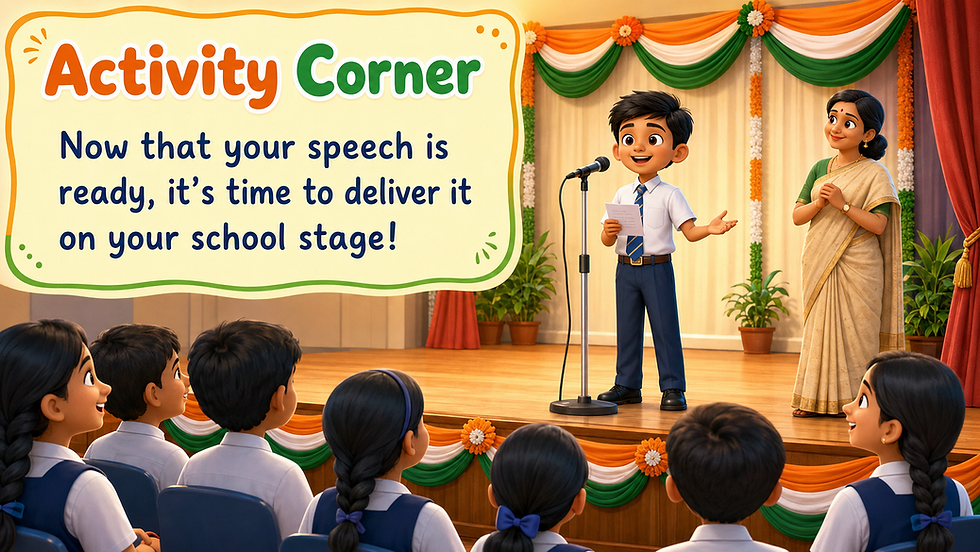
After the flag hoisting ceremony at school, Sahith was invited onto the stage to give a speech about the history of 15 August. Sahith greeted everyone and began:

“Respected teachers and my dear friends,
Today, we proudly celebrate India’s Independence Day. We know that the British ruled India for around 200 years and that many great national leaders fought courageously to free our country from colonial rule. But have you ever wondered why India became independent specifically on 15 August? There is an interesting story behind the date, and part of it begins with the Second World War.”
The World War Connection
“After the Second World War, many European countries were struggling financially. The United Kingdom was also in a difficult situation. At the same time, Indian national leaders and the people of India were no longer willing to accept foreign rule. Without enough money and the support of the Indian people, the British knew that they could not continue ruling India.
On 20 February 1947, the British Prime Minister announced that power would be transferred to Indian hands and that the British would leave the country by June 1948. Yes, you heard that correctly, June 1948! Then how did 15 August 1947 become our Independence Day? Was there a special story behind the date, just as there was behind the choice of 26 January?”
Why Exactly 15 August?
“The answer once again takes us back to the Second World War.
Lord Mountbatten was appointed the Viceroy of India, which meant that he was the head of the British government in India. His task was to make the transfer of power as smooth as possible and arrange a respectable exit for the British.
However, the situation in India was becoming worse every day. The Muslim League was demanding a separate country for Muslims called Pakistan. This demand led to growing tension and terrible riots in different parts of the country.
Lord Mountbatten therefore decided that the British should leave India as soon as possible. He brought the transfer of power forward from June 1948 and chose 15 August 1947 as the date of India’s independence.
But why did he select that particular date?”
A Question at a Press Conference
“The date was reportedly chosen by Lord Mountbatten while spontaneously answering a journalist’s question at a press conference. He selected 15 August because it was the date on which Japan announced its surrender during the Second World War in 1945.
This date was especially important to Lord Mountbatten because he had led the Allied forces against the Japanese forces in Southeast Asia during the war.
Based on Mountbatten’s recommendations, the Indian Independence Bill was quickly passed by the British Parliament. This set the end of British rule in India into motion. Finally, on 15 August 1947, India awoke as a free nation.”
Why Is the Flag Hoisted on 15 August?
“Did you know that our national flag is described as being ‘hoisted’ on Independence Day and ‘unfurled’ on Republic Day?
On Independence Day, the folded national flag is raised from the bottom of the flagpole to the top and then opened. This represents India rising from colonial rule and becoming an independent nation.
On Republic Day, the flag is already tied at the top of the pole in a folded form. When the rope is pulled, it opens and flies proudly. This is called unfurling.
Republic Day celebrates the adoption of our Constitution, which gave India its legal and democratic framework. It represents a nation that was already independent and had begun functioning under its own Constitution.
So, my dear friends, 15 August is not merely a date on the calendar. It marks the day when centuries of foreign rule finally ended and India stepped into a new dawn of freedom.
Thank you, and Jai Hind!”
Later, the principal congratulated Sahith on an amazing speech and asked him how he knew all the story? Sahith answered, "Yaksha Prashna magazine, you can also read one by subscribing at yakshaprashna.co.in sir!"
This story was published in July 2026 edition of Yaksha Prashna magazine. To read more such stories, get annual subscripton at YakshaPrashna.co.in


Comments